The Geography of Information: From TAT-8 to the Neutrino Horizon
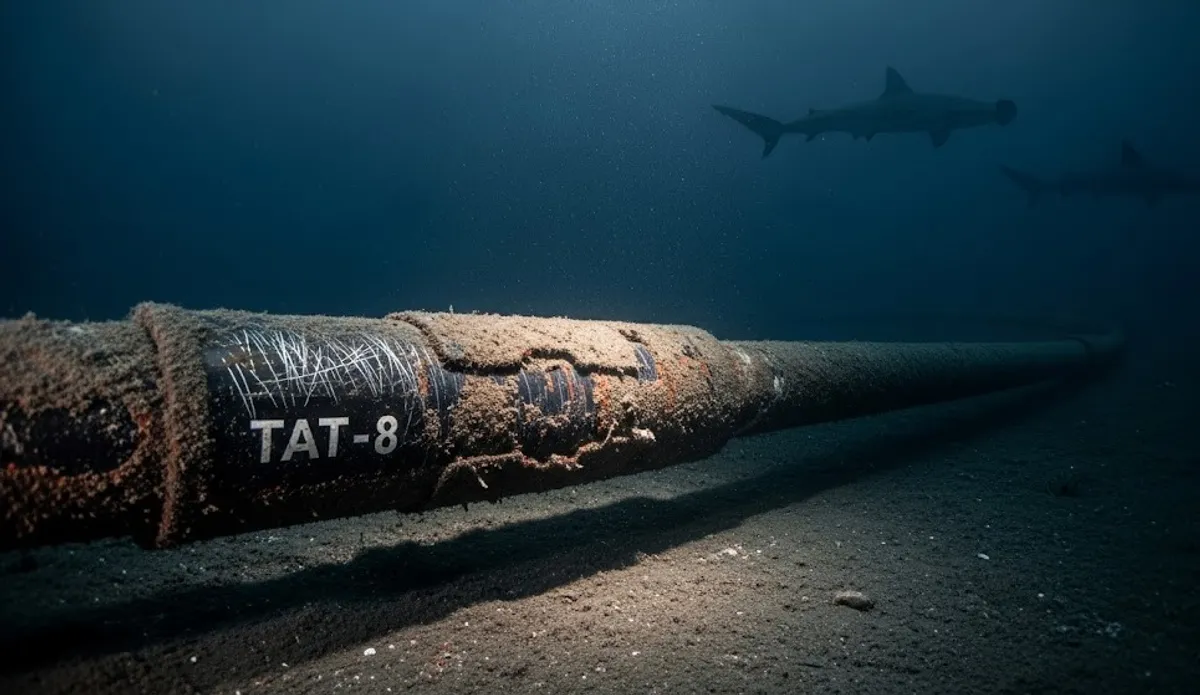
In 1988, the French cable ship C.S. Vercors and its international counterparts began laying TAT-8, the first trans-Atlantic fiber optic cable. Today, portions of this cable are being recovered from the Atlantic floor—not for their data, but for the raw materials and a technical post-mortem. TAT-8 was the “Big Bang” of the digital age, representing the moment the world’s nervous system transitioned from the electrical pulses of copper to the modulated light of glass.
This evolution is defined by a singular struggle: the fight against Friction. Whether it is the biological friction of sharks, the social friction of market regulation, or the political friction of privatization, the history of the bitstream is a record of our attempts to engineering “Straight Lines” in a curved, resistant world.
The Geopolitical Handshake: Strategic Sovereignty
TAT-8 was a massive cooperation between AT&T Bell Labs (USA), British Telecom (UK), and France Télécom (now Orange). This was not merely an engineering project; it was an exercise in strategic sovereignty [1]. France, in particular, refused to be a passive landing point for Anglo-American technology. They insisted on developing their own branching units and laying the European segments using the French fleet, specifically the C.S. Vercors [2].
The 1300nm Window: The Physics of the Path
The primary challenge of long-haul fiber is Signal Attenuation—the loss of light intensity. Engineers chose the 1300nm second window for TAT-8 because it was the “zero-dispersion” point for single-mode fiber [3]. In other wavelengths, different colors of light travel at slightly different speeds, causing a pulse to “spread out” (dispersion). At 1300nm, the pulse stays sharp, enabling the 280 Mbps throughput.
The Repeater: A 300kg Subatomic Laboratory
The common misconception is that fiber is a “magic pipe.” In reality, after 50km, the signal is a ghost. To solve this, TAT-8 utilized Optical Repeaters every 40-70 km.
Hardware, not Firmware: The Engineering of Reliability
In 1988, these repeaters were not running “firmware” or modern operating systems. They were comprised of discrete, high-reliability ECL (Emitter-Coupled Logic) and GaAs (Gallium Arsenide) FETs. The logic was hard-coded into the silicon by CIT Alcatel (France) and Bell Labs (USA) [1]. Firmware would have introduced a layer of “soft” instability that was unacceptable for a device designed to be inaccessible for 25 years.
- The Scale: Each repeater was a 1.5-meter long, 300kg high-tensile steel cylinder designed to survive 600 bar of pressure (6,000 meters deep) for 25 years.
- The 3R Challenge: They performed Re-amplification (photodiodes converting light to electricity), Re-shaping (cleaning noise via decision circuits), and Re-timing (synchronizing pulses to a master clock to prevent “jitter”).
Case Study 1: The Armor and the Shunt Fault
All TAT-8 partners utilized Sea Plows to bury the cable 1 meter into the silt of the continental shelves. However, even buried, the cable faced a biological threat: Sharks. The repeaters were powered by a DC current (1.6 Amps at 2,500 Volts), creating an electromagnetic field (EMF) that sharks, using their Ampullae of Lorenzini, mistook for the bioelectrical signals of prey [9].
- Shunt Faults: When a shark bit the cable, the puncture allowed seawater to “short” the power line to the ocean floor.
- Detection: Engineers used **Time Domain Reflectometry (TDR)**—measuring the “echo” of an electrical pulse to pinpoint the leak.
Case Study 2: The Social Friction of the Millisecond
While TAT-8 fought sharks, modern infrastructure fights the Speed of Light itself. In High-Frequency Trading (HFT), light in glass is 30% slower than light in a vacuum ($n \approx 1.46$).
The Proximity Paradox and Reg NMS
One would assume that whoever buys the rack closest to the cable “wins.” However, the US SEC’s Regulation NMS (specifically the “Fair Access” rules 610/611) [5] forced a design pivot to prevent market collapse due to proximity wars.
- The Equalization Spool: Inside data centers like Equinix LD4 (London) or NY4 (New Jersey), every participant is subjected to an “Equalized Cable Length.” If your rack is 5 meters from the switch and your competitor’s is 50 meters, the exchange will literally install a 45-meter spool of fiber in your path to ensure you have the exact same latency.
The Subatomic Bypass: Neutrinos
To escape the “Refractive Index Wall,” we must look at the Neutrino. Theoretically proposed by Wolfgang Pauli in 1930 to explain beta decay [4] and detected by Reines and Cowan in 1956, neutrinos pass through the entire Earth without stopping.
- The 2012 Breakthrough: Researchers at Fermilab (MINERvA) successfully encoded the word “Neutrino” into a pulsed beam and transmitted it through 240 meters of solid rock [4].
- The Interconnectivity Pivot: Because neutrinos travel in a straight line through the mantle (the chord distance), a message from NYC to Tokyo would travel roughly 11,000km compared to the 17,000km subsea route, providing a massive latency advantage without the “glass slowdown.”
Case Study 3: The Privatization Paradox (Germany vs. Canada)
The shift from the physical “straight line” of TAT-8 to the monetized “throttle” of HFT parallels the privatization of infrastructure—where the “Floor” of a nation is turned into a profit center.
The German ‘Postreform’ and the Dial-up Reality
The Postreform (1995) [6] privatized the Deutsche Bundespost into Telekom, Post, and Bahn.
- The Reality Check: While Germany mandated a “Right to Fast Internet” in 2022 (TKG § 157), the Bundesnetzagentur (the Federal Network Agency responsible for oversight) still records approximately 20,000 households utilizing dial-up or ISDN connections [8].
- The Idiocy Metric: At standard 56k speeds, loading the homepage of the Bundesnetzagentur (~4MB payload) would take approximately 11 to 14 minutes to render.
- The Subsidy Gap: Despite €30 billion in subsidies for the Gigabitstrategie [8], German fiber penetration lags at ~10% (OECD average is 36%), as private providers “cherry-pick” urban margins while rural infrastructure is ignored as “unprofitable.”
The Canadian Crown Model: Service at Cost
Contrast this with Hydro-Québec, a Canadian Crown corporation. Under the Hydro-Québec Act, the CEO is appointed with a mandate to provide power as a fundamental right, prioritizing “service-at-cost” for citizens over dividends [7].
- The “Social Contract”: Canada frequently “eats losses” in northern territories. The philosophy is that infrastructure is a loss-leader for the state to enable a profit center for the citizens. The CEO manages the social contract, not the stock price.
The Tech Pivot: Vacuum vs. Glass (Rivada and the OuterNet)
The final divergence is the move to Low Earth Orbit (LEO).
- Starlink (‘Bent Pipe’): Still tethered to ground stations and their associated “Kill-Switches.”
- Rivada (‘OuterNet’): A Munich-based startup using Optical Laser Inter-links (OISL) [10]. Light in a vacuum is 30% faster than in glass, allowing a Rivada mesh to beat a subsea cable on latency for any hop over 3,000km, providing “Ground-Independent” sovereignty.
The Architect’s Pivot: Reclaiming the Foundation
- Infrastructure is a Service: The foundation of a digital society should not be a profit center.
- Latency is the New Geography: Sovereignty belongs to those who own the “Straight Lines”—whether through the Earth (Neutrinos) or above it (Lasers).
- Harden the Edge: Our internal networks must be resilient enough to survive the failures of a macro-infrastructure managed for profit rather than uptime.
Technical References & Fact Checks
- **[1] TAT-8 Geopolitics:** Undersea Lightwave Communications. (IEEE Press, 1986). Link to IEEE Archive
- **[2] French Fleet History:** Orange Marine: The History of the C.S. Vercors. Link
- [3] Fiber Dispersion: Senior, J. M., Optical Fiber Communications: Principles and Practice (3rd Edition).
- **[4] Neutrino Discovery & Fermilab:** Stancil et al., “Demonstration of Communication using Neutrinos.” (2012). Link to ArXiv Paper
- **[5] SEC Reg NMS:** SEC Rule 610: Access to Quotations. Link to SEC.gov
- **[6] German Postreform:** Postumwandlungsgesetz (PostUmwG). Link to BMJ.de
- **[7] Canadian Crown Governance:** Hydro-Québec Act regarding public service mandates. Link to Hydro-Québec Governance
- **[8] German Dial-up & Fiber Data:** Bundesnetzagentur: Annual Report 2022/2023 - Broadband Market Analysis. Link to BNetzA
- [9] Shark EMF Sensitivity: Gill et al., “The Response of Electrosensitive Fish.” (2014).
- **[10] Rivada OISL:** Technical Whitepaper on Optical Inter-satellite Links. (2024). Link to Rivada Technology